Navigating multiple threats on Rio de Janeiro’s and Medellín’s peripheries
Standby urbanization is characterized by an active passivity of marginalized residents living either in high risk areas or social housing developments on urban peripheries. In this paper, I urbanize the concept of standby, coined by Laura Kemmer, Annika Kühn, Birke Otto and Vanessa Weber and extensively developed in their special issue in the journal ephemera.
To explore the effect of the violent presence of organized criminal actors, geological instabilities, and environmental disaster, I have developed the concept „dwelling in limbo“. To secure future dwelling, low-income populations are forced into supporting structures that perpetuate their marginality. Dwelling in limbo is not an accidental side-effect of urbanization, but a form of political violence inherent to the governing of urban peripheries.
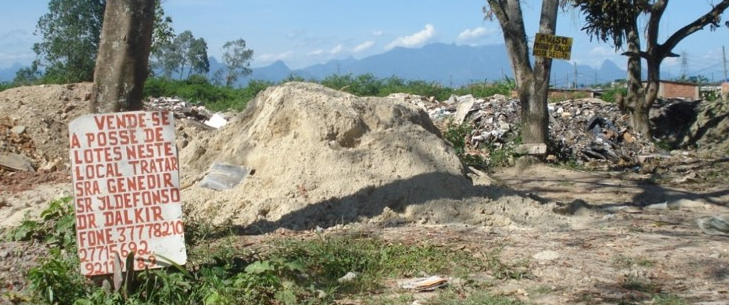
(C) Archive of Museu Vivo de Sao Bento, Duque de Caxias, Rio de Janeiro. Photography approx. from 2002
This blog aims at exploring the various – and interdependent – threats to which residents are exposed. Yet, beyond exposure, I wish to also highlight the multiple forms of agency of marginalized populations, including endurance, coping with, and actively resisting further marginalization. These issues are further explored in my research article „Standby urbanization: Dwelling and organized crime in Rio de Janeiro„.
This blog accompanies my resesarch project Weaponizing Social Housing in Rio de Janeiro and Medellín. It provides full text research articles, reflections on diverse aspects of my research topics, news and updates. My project has received funding from the European Union’s Horizon 2020 research and innovation programme under the Marie Sklodowska-Curie grant agreement No 898538.

 Standby Urbanization